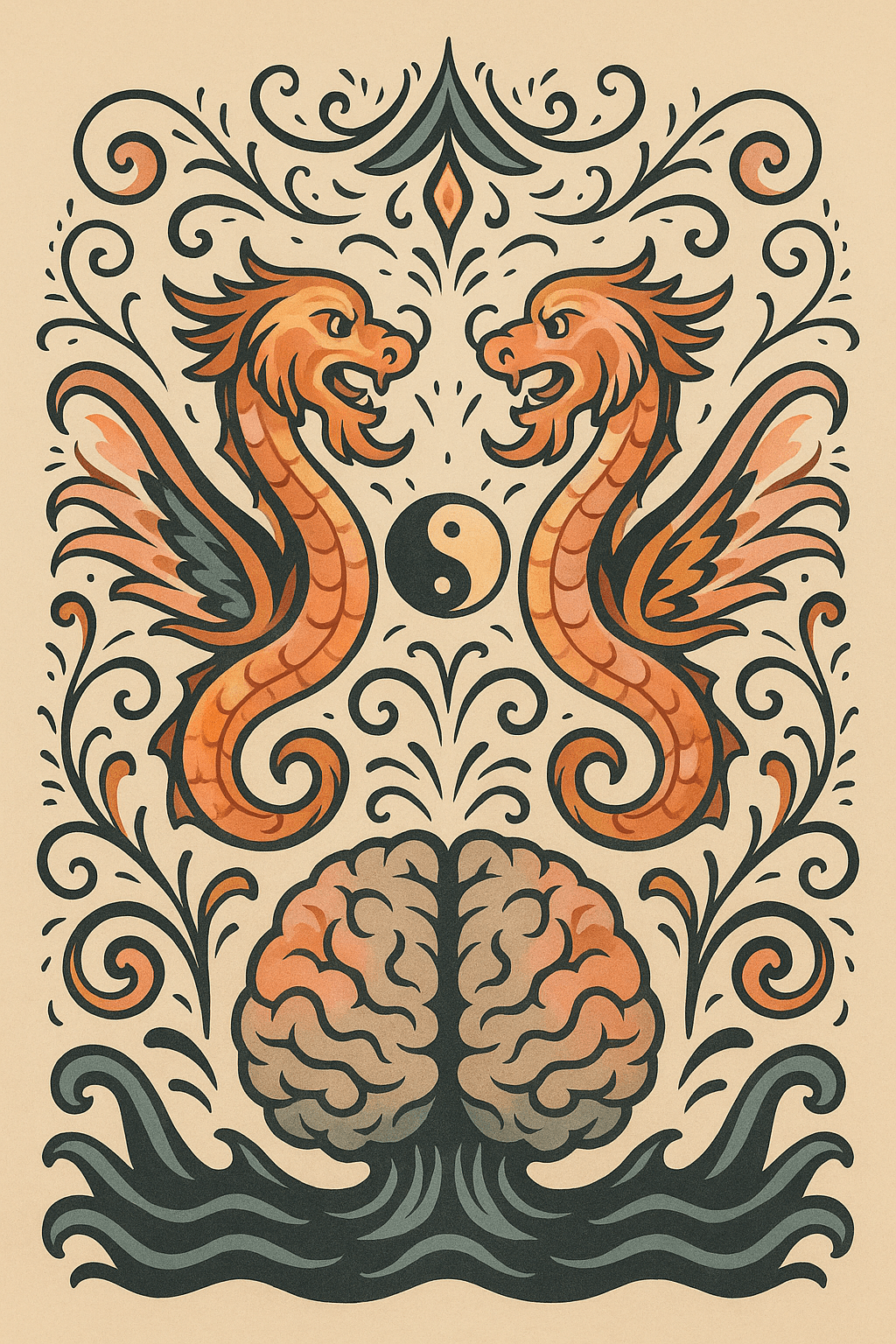
Notice the breath. In and out. Already, our mind begins to organize things into patterns, pairs. A pair that is in fact along one continuous spectrum or pole. We don’t have one without the other.
For centuries, people have told stories in twos: light and dark, masculine and feminine, hero and villain. These aren’t just poetic devices. They reflect how we live inside tension, and how meaning emerges not by choosing sides, but by holding the whole.
Our brains are wired to carry this design. Two hemispheres, left and right, always in conversation. Each with its own way of meeting the world. The left favors analysis, categories, precision. The right leans toward context, connection, nuance. There is no wall between them, but a dance. And here’s a curious twist: the left brain controls the right side of the body, the right brain controls the left. Opposites woven together from the start. Polarity is not an error; it is a feature.
Science is now able to show us this dance on brain scans, but it doesn’t stop there. Our very languages shape the wiring. A 2023 study from the Max Planck Institute compared German and Arabic speakers. Germans showed tighter connections inside the left hemisphere, where structure and syntax rule. Arabic speakers showed more bridges across both hemispheres, reflecting a language of roots and layered meanings, inviting mystery perhaps. How this has affected culture we may never fully know, but I for one say, let us dig deeper.
What does this mean? Wiring is not destiny, but it leaves its imprint. Language does not simply mirror culture, it shapes it. And culture reshapes language in return. They are locked in a feedback loop, each changing how we make meaning. We see the same rhythm in our oldest stories: spirit and matter, light and dark, self and other.
This impulse is alive in spiritual traditions as well. Yoga speaks of ida and pingala, lunar and solar channels weaving up the spine. When they come into balance, the central channel, sushumna, opens. That is where unity is said to dwell. Taoism names the pair yin and yang. Yoga calls them Shiva and Shakti. Christian mystics like Meister Eckhart spoke of spirit and flesh, not as enemies to divide, but as tensions to hold in one life.
Across traditions, pairs are not discarded. They are integrated. They need one another to exist. This is what we often miss in our desire for the good, the perfect, the beautiful. Every force, whether divine or human, carries an energetic counterpart, a dance partner of sorts. The opposite is not the enemy, but part of the same continuum.
And it isn’t only religion or philosophy that wrestles with rigidity and openness. This same tension plays out in how we treat science. We often hear the phrase: Trust the Science. But science isn’t a creed. It is a process. It requires both pattern perception and flexibility. It thrives by testing, retesting, and questioning. To trust science is to trust it will change. When treated like doctrine, it stops being science.
Metaphor works with patterns, yes, but it does not prove them. It reveals possibility and leaves room for interpretation. It gives us stories large enough to hold paradox, to say what data cannot. Science asks: Is it repeatable? Metaphor asks: Is it meaningful? One probes the mechanism. The other evokes the mystery. We need both to see more fully.
Let’s return to those old pairs: masculine and feminine, left and right, dark and light. They are not boxes to shove people into. They are not rigid truths. They are energies, patterns, ways of seeing. If we mistake the map for the terrain, we shrink ourselves. If we cling to only one map, we dull our curiosity.
Taoism reminds us: stay supple, not rigid. Curiosity itself is a sign the light is still on.
We are not here to settle the argument, but to deepen the questions. Let the myth be a mirror, not a prison. Let science guide you, not trap you in a fixed perspective. Walking the middle way softens our sense of division, often transforming fear into curiosity. When we stop clinging to sides, the path between them opens wide with possibility..
As Rumi said:
Out beyond ideas of wrongdoing and right doing,
there is a field. I’ll meet you there.
When the soul lies down in that grass,
the world is too full to talk about.
Ideas, language, even the phrase “each other”
doesn’t make any sense.
 PJ Davenport | Storytelling & Transformation—On & Off the Mat
Leave a comment