Before antibiotics, before our trust leaned so heavily on pills and prescriptions, sunlight was medicine. Not metaphorically, not poetically—clinically. In the late 1800s and early 1900s, hospitals didn’t just allow sunlight in—they were built around it. Sanatoria across Europe and the U.S. had sun decks, open-air balconies, whole wings designed so patients—especially those with tuberculosis—could spend hours a day in light and fresh air.
This wasn’t wishful thinking. It was reasoned, practiced, documented:
- Sunlight killed bacteria
- It boosted immune function
- It triggered the body’s own vitamin D production
- Patients recovering in sunlight healed faster. More completely.
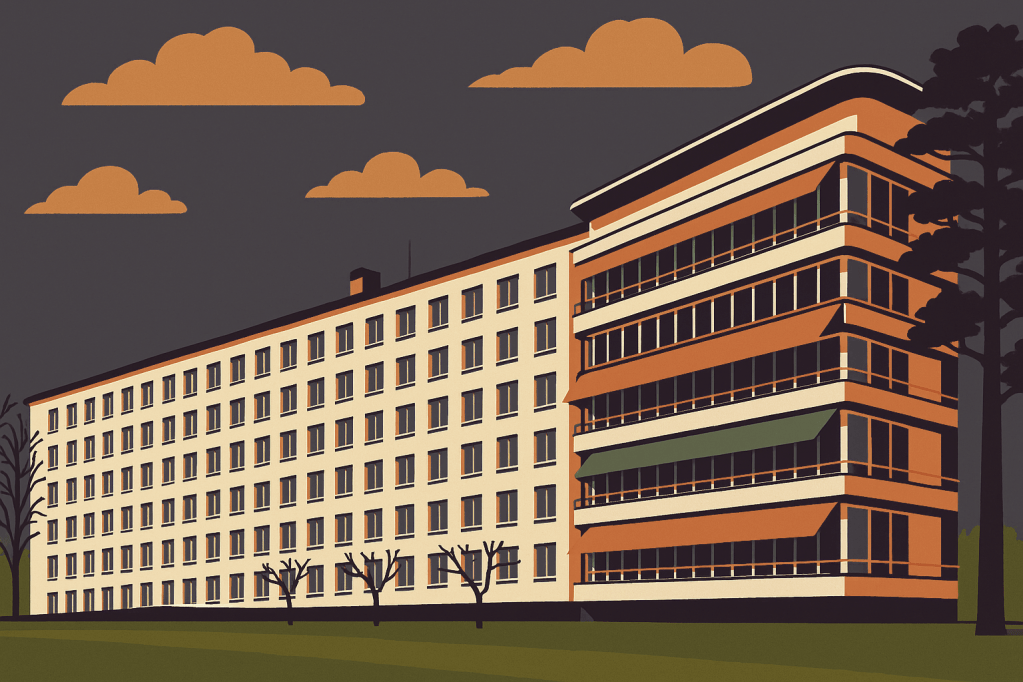
Take the Paimio Sanatorium in Finland, designed by Alvar Aalto in the 1930s. Nothing was accidental. Window placement, bed orientation, airflow—all of it was tuned to support healing. Not just to house the sick, but to help them recover.
The Industrial Eclipse
Then came antibiotics. Streptomycin, sulfa drugs, penicillin—and just like that, sunlight wasn’t the center of the story anymore. Not because it had failed, but because something louder had arrived.
Hospitals changed. Architecture followed industry. Windows sealed shut. Balconies vanished. Fluorescent lighting replaced natural rays. Clean, efficient, controlled—that was the new ethos. Healing became something that happened indoors, under supervision, away from the elements.
It wasn’t just a shift in treatment. It was a shift in worldview.
The Sun as Scapegoat
As the medical world closed its windows, public sentiment followed. The sun, once a symbol of health and vitality, turned suspect. Something to avoid.
- Sunscreen became standard—many loaded with chemicals that quietly interfered with hormones
- Sunglasses turned everyday, blocking light essential for circadian signaling
- Health messaging fixated on skin cancer, rarely speaking to light’s benefits
Instead of learning how to be in the sun wisely, we were taught to fear it altogether.
The Body Remembers
Still, the body doesn’t forget. Biology evolved under sunlight, and it shows.
- Circadian rhythms are set by full-spectrum light reaching the eyes
- Red and near-infrared light support mitochondria—the engines inside every cell
- Daylight affects mood, focus, and overall mental health
We now pay for what was once free: phototherapy for skin conditions, red light to energize our cells, UVB lamps to simulate sunlight and synthesize vitamin D. The same principles, only medicalized and monetized. Packaged light, sold back to us.
Sacred Origins
Our connection to the sun goes back far deeper than sanatoria. Long before medicine, light was sacred.
- The Romans called it Sol Invictus — the Unconquered Sun
- Greeks honored Helios, then Apollo
- Egyptians worshipped the great Ra
- The Aztecs and Mayans built temples and calendars around its arc
Solstices. Equinoxes. Dying-and-rising gods. These weren’t just stories—they were ways of keeping time, marking life, and honoring the force that made crops grow and skin glow. A kind of ecological literacy, written in myth.

Reclaiming the Light
Sunlight was never discarded because it stopped working. It was sidelined by systems with different priorities.
So maybe the question isn’t does sunlight heal? It always has. The better question is: what did we lose when we forgot that? And how might we begin to remember?
Because sunlight—used with care—was and will always be medicine. It’s freely given, and gently waiting, whenever we’re ready to receive it.
 PJ Davenport | Storytelling & Transformation—On & Off the Mat
Leave a comment